Lunatics, Imbeciles and Idiots by Kathryn Burtinshaw
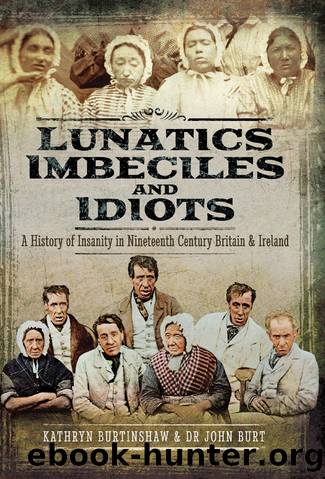
Author:Kathryn Burtinshaw
Language: eng
Format: epub
Publisher: Pen & Sword Books
Published: 2017-08-15T00:00:00+00:00
Murray Asylum Perth. Group of female patients, 1860. Courtesy of Dundee University Archive Services.
Murray Asylum Perth. Group of male patients, 1860. Courtesy of Dundee University Archive Services.
Asylums employed skilled tradesmen such as shoemakers, blacksmiths and engineers and the patients worked alongside these people using the skills they already had, but also acquiring new ones to aid in the running of the institution. The majority of asylums had a farm, land and market garden, which were used to provide food for the patients and staff. The male patients in particular were encouraged to help with the farm labour and gardening. Those unsuited to outdoor work were often requested to repair bedding and clean hair and flock mattresses.
At the Surrey County Lunatic Asylum at Brookwood patients and attendants were reported to work together in such harmony and companionship that it was often difficult to differentiate between them. Outdoor labour and works carried on within the asylum were arranged to provide varied sources of interest and promote positive remedial treatment.
Leisure activities
Recreation was considered an important part of recovery and rehabilitation and asylums provided many activities for the benefit of patients. Asylum staff were expected to participate and encourage patients to avail themselves of the opportunities provided for them. Music, dancing, libraries and sport were just some of the activities available to those willing to participate.
Music and theatre
At the Crichton Royal Institution in Dumfries, Scotland, Dr W.A.F. Browne (1805–85) introduced a variety of activities ‘to sweeten confinement, and to promote the cheerfulness of minds’ of the patients as early as 1840. One of these was music. Browne considered music to be a means of bringing the asylum community together. A variety of instruments were played by patients in the wards, at concerts, and at asylum theatricals, and also by asylum staff. In 1840, Glasgow Royal Asylum paid for a music teacher to give music lessons twice a week. As a result, patients learned new skills and gained confidence.
Dancing, Montrose Royal Asylum. Courtesy of Dundee University Archive Services.
Download
This site does not store any files on its server. We only index and link to content provided by other sites. Please contact the content providers to delete copyright contents if any and email us, we'll remove relevant links or contents immediately.
The Art of Coaching by Elena Aguilar(53645)
Thinking, Fast and Slow by Kahneman Daniel(12526)
The Art of Thinking Clearly by Rolf Dobelli(10719)
The 5 Love Languages: The Secret to Love That Lasts by Gary Chapman(10010)
Mindhunter: Inside the FBI's Elite Serial Crime Unit by John E. Douglas & Mark Olshaker(9519)
When Breath Becomes Air by Paul Kalanithi(8590)
Periodization Training for Sports by Tudor Bompa(8417)
Becoming Supernatural by Dr. Joe Dispenza(8368)
Turbulence by E. J. Noyes(8209)
Bodyweight Strength Training by Jay Cardiello(8029)
Nudge - Improving Decisions about Health, Wealth, and Happiness by Thaler Sunstein(7852)
Therapeutic Modalities for Musculoskeletal Injuries, 4E by Craig R. Denegar & Ethan Saliba & Susan Saliba(7779)
The Road Less Traveled by M. Scott Peck(7730)
Mastermind: How to Think Like Sherlock Holmes by Maria Konnikova(7546)
Enlightenment Now: The Case for Reason, Science, Humanism, and Progress by Steven Pinker(7423)
Win Bigly by Scott Adams(7345)
Kaplan MCAT General Chemistry Review by Kaplan(7054)
Why We Sleep: Unlocking the Power of Sleep and Dreams by Matthew Walker(6853)
The Way of Zen by Alan W. Watts(6732)
